How to Master OSCE Exams & Clinical Rotations

The success of medical school doesn't mean just passing the exams in the written form; it's about being confident during real-life clinical situations.
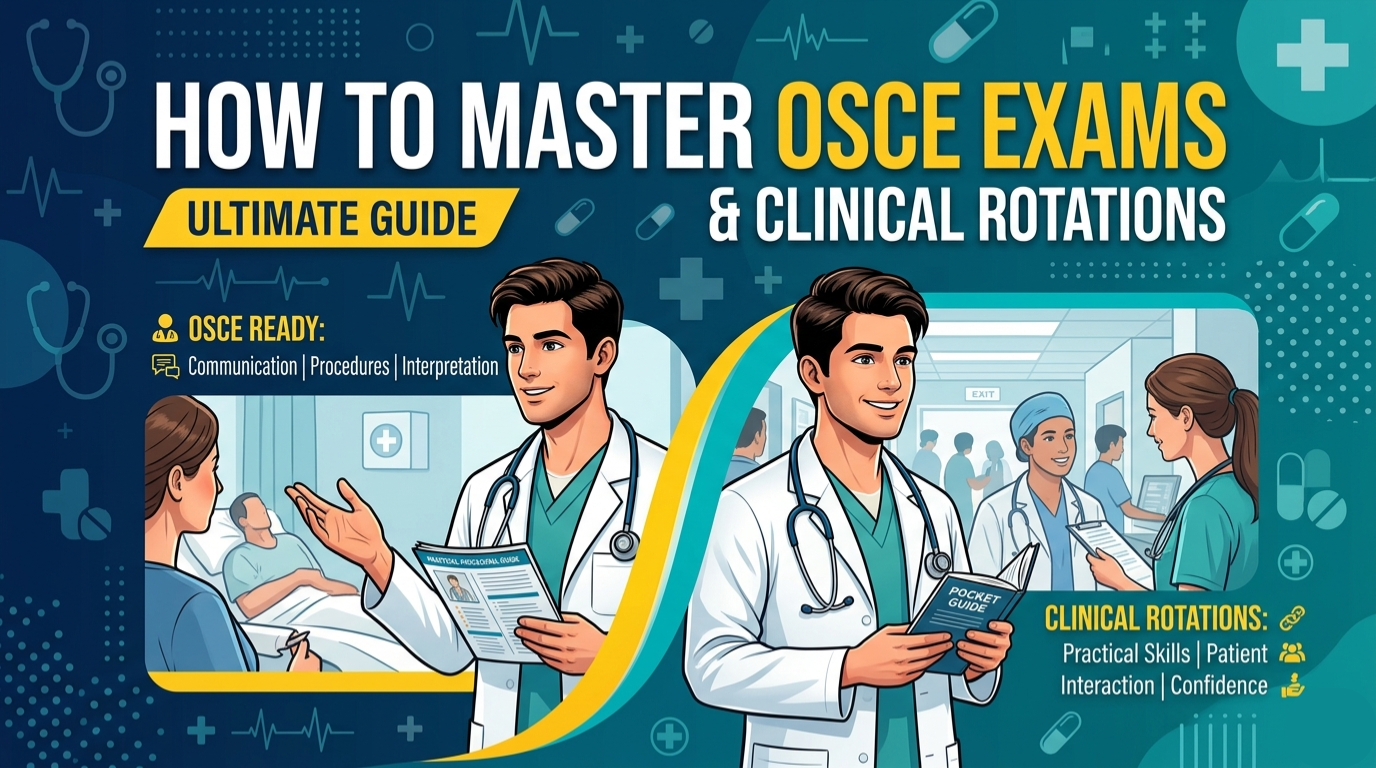
The success of medical school doesn't mean just passing the exams in the written form; it's about being confident during real-life clinical situations. OSCEs (Objective Structured Clinical Exams) as well as clinical rotations assess your ability to apply your knowledge, effectively communicate and be able to make informed decisions under pressure.
A lot of students are overwhelmed by the fact that they have to learn both the theory and practical abilities. What can they do? An organized approach that blends intelligent study methods with high-yield materials.
That's where platforms like Med School Bro come in. They provide concise guides for pocketbooks as well as flashcards that are specific. They help students concentrate on the things that matter most - saving time and improving their performance.
Step 1: Understand What OSCEs Really Test
OSCE tests are made to replicate real-world medical situations. Each station is designed to test a certain aptitude, for example, the ability to take a history, physical exam, communications, diagnosis, etc.
Contrary to conventional tests that evaluate you on your performance, this test is based on how you've performed, not only the things you've learned. That means that your attitude, as well as your confidence and approach, are equally important as the knowledge you have.
Knowing this will help you move your focus from passive studying to active.
Step 2: Break Down High-Yield Clinical Areas
OSCEs always focus on the basic systems and frequently tested scenarios. This includes cardiovascular examinations and respiratory tests, as well as tests for neurological health and gastrointestinal examinations.
Instead of tackling everything simultaneously, concentrate on these areas with the highest yield before studying the rest of your subjects. Pocket guides that are organized can assist you with step-by-step exam techniques, without losing yourself in the information.
This method of planning ensures that you're prepared for the most likely scenario.
Step 3: Use a Pocket Guide for Quick, Efficient Learning
An incredibly compact guidebook, like the OSCE pocket guide, is considered to be one of the most efficient instruments to use for students in medicine. It combines essential clinical knowledge into checklists that are easy to follow and can be reviewed at any time.
From the history-taking and communication methods to surgical procedures and protocols for resuscitation, everything is organized to make it easy for you to access. This is particularly helpful in rotations where there is a short time frame.
The convenience of having a portable reference lets you revise in between lessons, during tests, or even in the course of your clinical.
Step 4: Master Communication and Patient Interaction
Communication is an essential component of OSCE examinations. It is possible to share the bad news, conduct interviews, or conduct the task of motivational counseling.
This type of situation requires understanding, clarity, and professionalism. The practice of structured communication methods will help you remain focused and effectively communicate information.
Strong communication skills not only enhance your performance on exams but also allow you to prepare for interactions with patients in your career in medicine.
Step 5: Practice Clinical Procedures Repeatedly
OSCEs usually include practical processes, including IV cannulation, venepuncture, and catheterization, as well as the protocols for managing infections. They require the highest level of precision and trust.
The best method to become proficient at the concepts is to practice them repeatedly. Practice in a structured manner, often, and regularly simulate examination situations.
In time, these techniques get easier, allowing the user to function smoothly even when under stress.
Step 6: Strengthen Diagnostic and Interpretation Skills
A further important aspect of OSCEs is the interpretation of the clinical information. There are times when you'll be asked to review ECGs or analyze chest X-rays or evaluate laboratory results.
Instead of memorizing patterns, focus on understanding the rationale of these patterns. This will help you respond to the follow-up questions with confidence and accuracy.
A regular practice session with diagnosing scenarios increases efficiency and the ability to make decisions.
Step 7: Use Flashcards to Reinforce Core Knowledge
Although OSCEs are exams that can be used for practical purposes having a solid theoretical background is vital. Flashcards are among the best ways to strengthen important concepts in a short amount of time.
An extensive MCAT flashcard set that covers topics like chemistry, biology, as well as psychology and physics can help you build a strong base.
Through Active Recall, you can improve recall and ensure that crucial facts remain intact in your memory.
Step 8: Prepare for Clinical Rotations Simultaneously
Clinical rotations can be a part of the OSCE training. While on rotations, you'll interact with real patients as well as get asked questions on the spot by the supervisors.
An easy-to-read resource such as 'Don't Be Pimped' Pocket Guide can help to be prepared for such scenarios. It lets you go over the most important aspects of pediatrics, internal medicine, surgeries, and many other areas.
It ensures that you're prepared for your exams, but comfortable in the real world of clinical environments.
Step 9: Practice Under Exam Conditions
It is vital to manage time when it comes to OSCE examinations. Every station is timed, and it is imperative to finish tasks in a timely manner without missing crucial elements.
You can practice using a timer in order for a simulation of exam conditions. This will help you organize your plan, remain focused, and not rush.
As you work on your exam under stress, the more relaxed and relaxed you'll appear when you take the exam.
Final Thoughts
Learning to pass OSCE examinations and clinical rounds involves a combination of understanding and practice and strategy. Focusing on topics that yield high returns that you can master consistently and employing structured materials to improve your score.
Brands such as Med School Bro make this procedure simpler by offering practical instruments that make complex concepts easier to understand and facilitate efficient learning.
If you take the proper method, you will go from feeling overwhelmed to being confident and prepared about your skills.
FAQs
Q1: What effectively prepares to pass the OSCE exam?
Focus on learning clinical skills with structured guidebooks as well as revising topics with high yield frequently.
Q2: Can flashcards be beneficial to medical school students?
Yes, flashcards increase memory and retention. The most important ideas quickly.
Q3: What is the most important thing I concentrate on during my clinic rotations?
Prioritize interactions with patients, the most important clinical competencies, and rapid revision with portable study materials.